
Welcome to the Graptolite subsite on Invertebrate Paleontology!
Please enter a genera name to retrieve more information.
Testograptus
Classification
Phylum:
Hemichordata
Class:
Pterobranchia
Subclass:
Graptolithina
Order:
Graptoloidea
Suborder:
Axonophora
Infraorder:
Neograptina
Superfamily:
Monograptoidea
Family:
Monograptidae
Subfamily:
Monograptinae - Subset of taxa without cladia
Formal Genus Name and Reference:
Testograptus Pर̌ıbyl, 1967a, p. 49, ex Monograptus (Testograptus) Pर̌ibyl, 1967a, p. 49, Loydell & CAVE, 1994, p. 612
Type Species:
*Graptolithus testis BARRANDE, 1850, OD
Images
(Click to enlarge in a new window)
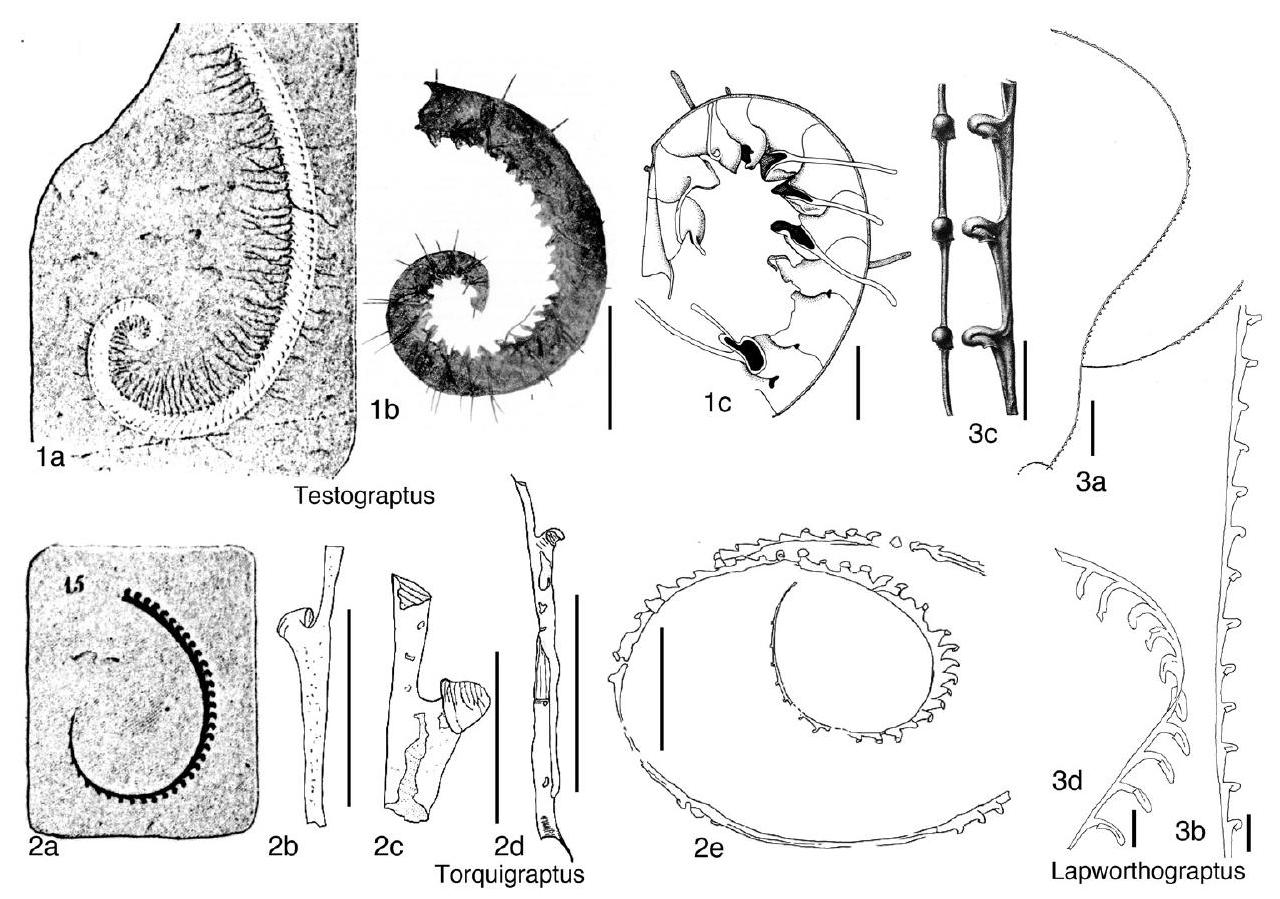 Fig. 301,1 a-c. * T. testis (Barrande), 1 a, ?lectotype, scale unknown (Barrande, 1850, pl. 3.19), 1b, isolated specimen, scale bar, 5 mm (Urbanek & Teller, 1974, pl. 24), 1c, small isolated specimen showing tubarium details, scale bar, 1 mm (Urbanek & Teller, 1974, fig. 1)
Synonyms
Geographic Distribution
world-wide
Age Range
Beginning Stage in Treatise Usage:
Silurian (Wenlock (Homerian, Cyrtograptus lundgreni Biozone))
Beginning International Stage:
Homerian
Fraction Up In Beginning Stage:
0
Beginning Date:
430.62
Ending Stage in Treatise Usage:
Silurian (Wenlock, Homerian, Cyrtograptus lundgreni Biozone)
Ending International Stage:
Homerian
Fraction Up In Ending Stage:
100
Ending Date:
426.74
Description
Tubarium planispirally and ventrally coiled through up to 450°, curvature strongest proximally with abrupt ventral flexure immediately distal of sicular apex, sicula weakly ventrally curved, tubarium development occasionally by means of pseudovirgula, thecae biform, with long, paired, laterally directed spines, proximalmost thecae with strongly hooked metatheca, distal thecae with lesser hook, thecal overlap -50-75%.
References
Museum or Author Information
Classification
Phylum:
Hemichordata
Class:
Pterobranchia
Subclass:
Graptolithina
Order:
Graptoloidea
Suborder:
Axonophora
Infraorder:
Neograptina
Superfamily:
Monograptoidea
Family:
Monograptidae
Subfamily:
Monograptinae - Subset of taxa without cladia
Formal Genus Name and Reference:
Testograptus Pर̌ıbyl, 1967a, p. 49, ex Monograptus (Testograptus) Pर̌ibyl, 1967a, p. 49, Loydell & CAVE, 1994, p. 612
Type Species:
*Graptolithus testis BARRANDE, 1850, OD
Images
(Click to enlarge in a new window)
Fig. 301,1 a-c. * T. testis (Barrande), 1 a, ?lectotype, scale unknown (Barrande, 1850, pl. 3.19), 1b, isolated specimen, scale bar, 5 mm (Urbanek & Teller, 1974, pl. 24), 1c, small isolated specimen showing tubarium details, scale bar, 1 mm (Urbanek & Teller, 1974, fig. 1)
Synonyms
Geographic Distribution
world-wide
Age Range
Beginning Stage in Treatise Usage:
Silurian (Wenlock (Homerian, Cyrtograptus lundgreni Biozone))
Beginning International Stage:
Homerian
Fraction Up In Beginning Stage:
0
Beginning Date:
430.62
Ending Stage in Treatise Usage:
Silurian (Wenlock, Homerian, Cyrtograptus lundgreni Biozone)
Ending International Stage:
Homerian
Fraction Up In Ending Stage:
100
Ending Date:
426.74
Description
Tubarium planispirally and ventrally coiled through up to 450°, curvature strongest proximally with abrupt ventral flexure immediately distal of sicular apex, sicula weakly ventrally curved, tubarium development occasionally by means of pseudovirgula, thecae biform, with long, paired, laterally directed spines, proximalmost thecae with strongly hooked metatheca, distal thecae with lesser hook, thecal overlap -50-75%.