
Welcome to the Graptolite subsite on Invertebrate Paleontology!
Please enter a genera name to retrieve more information.
Pseudisograptus
Classification
Phylum:
Hemichordata
Class:
Pterobranchia
Subclass:
Graptolithina
Order:
Graptoloidea
Suborder:
Glossograptina
Family:
Isograptidae
Subfamily:
Arienigraptinae
Formal Genus Name and Reference:
Pseudisograptus BEAVIS, 1972, p. 202
Type Species:
* Didymograptus caduceus var. manubriatus T. S HALL, 1914, p. 108, OD
Images
(Click to enlarge in a new window)
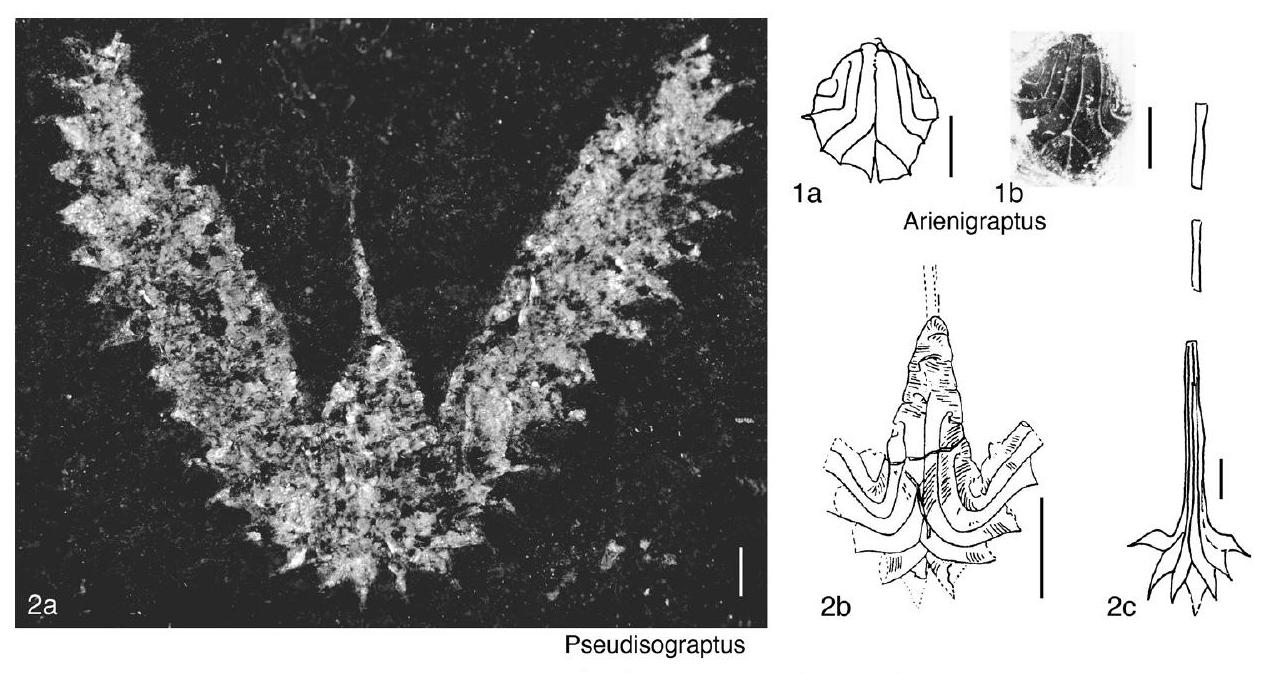 Fig. 211,2a. { }^{*} P. manubriatus manubriatus (T. S. Hall), holotype, NMV P31176 scale bar, 1 mm (VandenBerg & Maletz, 2016, fig. 1A), Fig. 211,2b. P. manubriatus janus Cooper & Ni, 1986, reverse view, scale bar, 1 mm (Cooper & Ni, 1986, fig. 17B), ——Fig. 211,2c. P. songxiensis (Yu & Fang), holotype NIGP 50021, scale bar, 1 mm (adapted from Yang & others, 1983, fig., ——Fig. 211,2c. P. songxiensis (Yu & Fang), holotype NIGP 50021, scale bar, 1 mm (adapted from Yang & others, 1983, fig. 1)
Synonyms
Geographic Distribution
Australia, New Zealand, China, Russia, UK, Norway, Sweden, USA, Canada, Argentina
Age Range
Beginning Stage in Treatise Usage:
Middle Ordovician (upper Dapingian, Oncograptus upsilon)
Beginning International Stage:
Dapingian
Fraction Up In Beginning Stage:
50
Beginning Date:
470.34
Ending Stage in Treatise Usage:
Middle Ordovician (lower Darriwilian, Levisograptus austrodentatus Biozone)
Ending International Stage:
Darriwilian
Fraction Up In Ending Stage:
50
Ending Date:
463.8
Description
Two-stiped, reclined, manubriate isograptids with complex arienigraptid proximal structure and isograptid to maeandrograptid symmetry, arienigraptid suture between th $1^{2}$ and th $2^{1}$ usually covered by overlap of later thecae, manubrium wedge of highly variable dimensions, proximal development type isograptid, dextral, with delayed dicalycal theca, sicula strongly elongated, th $1^{2}$ with left-handed origin, thecae of advanced manubriate style, stipes sometimes poorly developed, intrathecal folds present
References
Beavis, F. C. 1972. The manubriate isograptids. Geological Magazine 109(3):193-204.
Museum or Author Information
Classification
Phylum:
Hemichordata
Class:
Pterobranchia
Subclass:
Graptolithina
Order:
Graptoloidea
Suborder:
Glossograptina
Family:
Isograptidae
Subfamily:
Arienigraptinae
Formal Genus Name and Reference:
Pseudisograptus BEAVIS, 1972, p. 202
Type Species:
* Didymograptus caduceus var. manubriatus T. S HALL, 1914, p. 108, OD
Images
(Click to enlarge in a new window)
Fig. 211,2a. { }^{*} P. manubriatus manubriatus (T. S. Hall), holotype, NMV P31176 scale bar, 1 mm (VandenBerg & Maletz, 2016, fig. 1A), Fig. 211,2b. P. manubriatus janus Cooper & Ni, 1986, reverse view, scale bar, 1 mm (Cooper & Ni, 1986, fig. 17B), ——Fig. 211,2c. P. songxiensis (Yu & Fang), holotype NIGP 50021, scale bar, 1 mm (adapted from Yang & others, 1983, fig., ——Fig. 211,2c. P. songxiensis (Yu & Fang), holotype NIGP 50021, scale bar, 1 mm (adapted from Yang & others, 1983, fig. 1)
Synonyms
Geographic Distribution
Australia, New Zealand, China, Russia, UK, Norway, Sweden, USA, Canada, Argentina
Age Range
Beginning Stage in Treatise Usage:
Middle Ordovician (upper Dapingian, Oncograptus upsilon)
Beginning International Stage:
Dapingian
Fraction Up In Beginning Stage:
50
Beginning Date:
470.34
Ending Stage in Treatise Usage:
Middle Ordovician (lower Darriwilian, Levisograptus austrodentatus Biozone)
Ending International Stage:
Darriwilian
Fraction Up In Ending Stage:
50
Ending Date:
463.8
Description
Two-stiped, reclined, manubriate isograptids with complex arienigraptid proximal structure and isograptid to maeandrograptid symmetry, arienigraptid suture between th $1^{2}$ and th $2^{1}$ usually covered by overlap of later thecae, manubrium wedge of highly variable dimensions, proximal development type isograptid, dextral, with delayed dicalycal theca, sicula strongly elongated, th $1^{2}$ with left-handed origin, thecae of advanced manubriate style, stipes sometimes poorly developed, intrathecal folds present
References
Beavis, F. C. 1972. The manubriate isograptids. Geological Magazine 109(3):193-204.