
Welcome to the Graptolite subsite on Invertebrate Paleontology!
Please enter a genera name to retrieve more information.

Eotetragraptus
Classification
Phylum:
Hemichordata
Class:
Pterobranchia
Subclass:
Graptolithina
Order:
Graptoloidea
Suborder:
Sinograptina
Family:
Sigmargraptidae
Subfamily:
Multiramous to two-stiped genera with simple thecae, differentated rutellum on sicula and typically with lateral lobes
Formal Genus Name and Reference:
Eotetragraptus Bouček \& Pर̌IBYL, 1952a, p. 7
Type Species:
*Graptolithus quadribrachiatus HALL, 1858, p. 125, OD
Images
(Click to enlarge in a new window)
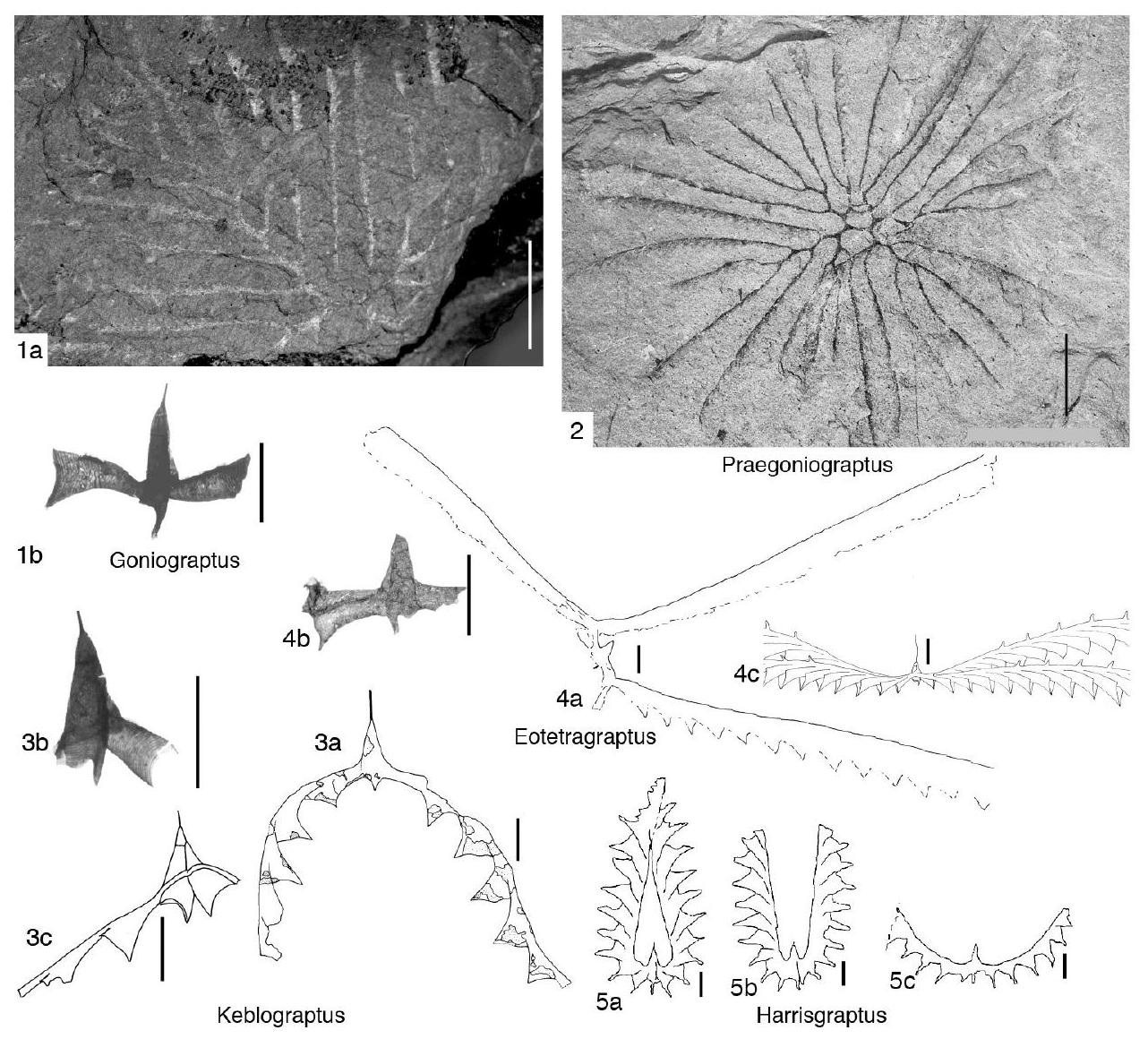 Fig. 172,4a-b. E. quadribrachiatus (Hall), 4a, syntype, GSC 928 b , specimen shows the distinct rutellum on the sicula, Lévis, Quebec, Canada, scale bar, 1 mm (new), 4 b, GSC 132327, obverse view of flattened proximal end, Bay Cove, western Newfoundland, Canada, scale bar, 1 mm (new), Fig. 172,4c. E. acanthonotus (Gurley, 1896), scale bar, 1 mm (new, reconstruction based on Maletz, 1997b, fig. 7N)
Synonyms
Geographic Distribution
worldwide
Age Range
Beginning Stage in Treatise Usage:
Middle Ordovician (Darriwilian, Levisograptus austrodentatus Biozone)
Beginning International Stage:
Darriwilian
Fraction Up In Beginning Stage:
0
Beginning Date:
469.42
Ending Stage in Treatise Usage:
Middle Ordovician (Darriwilian, Pterograptus elegans Biozone)
Ending International Stage:
Darriwilian
Fraction Up In Ending Stage:
100
Ending Date:
458.18
Description
Four-stiped sigmagraptines with simple, rutellate, commonly considerably curved thecae, stipes pendent to reclined and reflexed, rarely with dorsal spines, short and wide sicula with distinct rutellum and lateral apertural lobes, proximal development isograptid, dextral, with symmetrically placed slender crossing canals, thecal style simple, widening tubes with rutellate apertures, often with slight lateral lobes
References
Museum or Author Information
Classification
Phylum:
Hemichordata
Class:
Pterobranchia
Subclass:
Graptolithina
Order:
Graptoloidea
Suborder:
Sinograptina
Family:
Sigmargraptidae
Subfamily:
Multiramous to two-stiped genera with simple thecae, differentated rutellum on sicula and typically with lateral lobes
Formal Genus Name and Reference:
Eotetragraptus Bouček \& Pर̌IBYL, 1952a, p. 7
Type Species:
*Graptolithus quadribrachiatus HALL, 1858, p. 125, OD
Images
(Click to enlarge in a new window)
Fig. 172,4a-b. E. quadribrachiatus (Hall), 4a, syntype, GSC 928 b , specimen shows the distinct rutellum on the sicula, Lévis, Quebec, Canada, scale bar, 1 mm (new), 4 b, GSC 132327, obverse view of flattened proximal end, Bay Cove, western Newfoundland, Canada, scale bar, 1 mm (new), Fig. 172,4c. E. acanthonotus (Gurley, 1896), scale bar, 1 mm (new, reconstruction based on Maletz, 1997b, fig. 7N)
Synonyms
Geographic Distribution
worldwide
Age Range
Beginning Stage in Treatise Usage:
Middle Ordovician (Darriwilian, Levisograptus austrodentatus Biozone)
Beginning International Stage:
Darriwilian
Fraction Up In Beginning Stage:
0
Beginning Date:
469.42
Ending Stage in Treatise Usage:
Middle Ordovician (Darriwilian, Pterograptus elegans Biozone)
Ending International Stage:
Darriwilian
Fraction Up In Ending Stage:
100
Ending Date:
458.18
Description
Four-stiped sigmagraptines with simple, rutellate, commonly considerably curved thecae, stipes pendent to reclined and reflexed, rarely with dorsal spines, short and wide sicula with distinct rutellum and lateral apertural lobes, proximal development isograptid, dextral, with symmetrically placed slender crossing canals, thecal style simple, widening tubes with rutellate apertures, often with slight lateral lobes